Santa Maria, CA · Garage Door Service
Callender's houses mostly went up after 1987, later than most of the Santa Maria service area. That gap changes what a new door install here actually involves.
Callender is a small pocket, something like 949 households, which means the jobs here don't come in waves the way they do in bigger tracts. When a door finally needs replacing, it's usually because the original unit has just worn out, not because a run of identical failures hit a whole block at once. The housing in the wider Santa Maria service area was mostly put up between 1969 and 2012, with 1979 as the median year. Callender's own stock runs later than that, closer to 1987 on the median. That ten-year gap matters: a door installed when a Callender house was built is a different animal from the one-piece wood-panel doors still hanging in the older 1960s-era tracts nearby. You're more likely dealing with a steel sectional door on a factory-installed torsion system that's simply reached the end of its service life after three-plus decades of daily cycles, springs stretched thin, rollers worn oval, than with the older hardware that shows up elsewhere in the area. Household income here runs higher than the broader service-area median of $103,258, which tends to mean owners replace a tired door before it fails outright rather than patching it one more time.
A new install isn't a same-day fix in most cases, and Callender doesn't change that math. The door itself, opener, and track have to be right for the opening before anyone can hang them, so there's a measure-and-order step before a truck ever leaves Santa Maria for the 11-mile run out to Callender. Once the parts are on hand, the physical swap for a single door usually runs half a day; a double door with a new opener takes longer. What we can't promise is a same-visit turnaround if what's ordered isn't what shows up, or if the opening turns out to be non-standard once the old door comes down. We'd rather tell a homeowner the honest lead time up front than guess low and miss it.
Some of what a new install involves is fine for a handy owner: pulling the old door panels down once springs are safely relieved, clearing the opening, even repainting trim while the bay is open. What isn't a DIY job is anything involving the torsion spring under tension or setting the new door's balance against its own opener. On a door built for a house from the late 1980s, the spring is sized for that door's specific weight, and getting it wrong isn't a minor mistake, it's the kind that puts someone in the ER. If you want to save labor cost, do the demo prep and the cleanup yourself and let a trained hand do the spring, cable, and opener work in between.
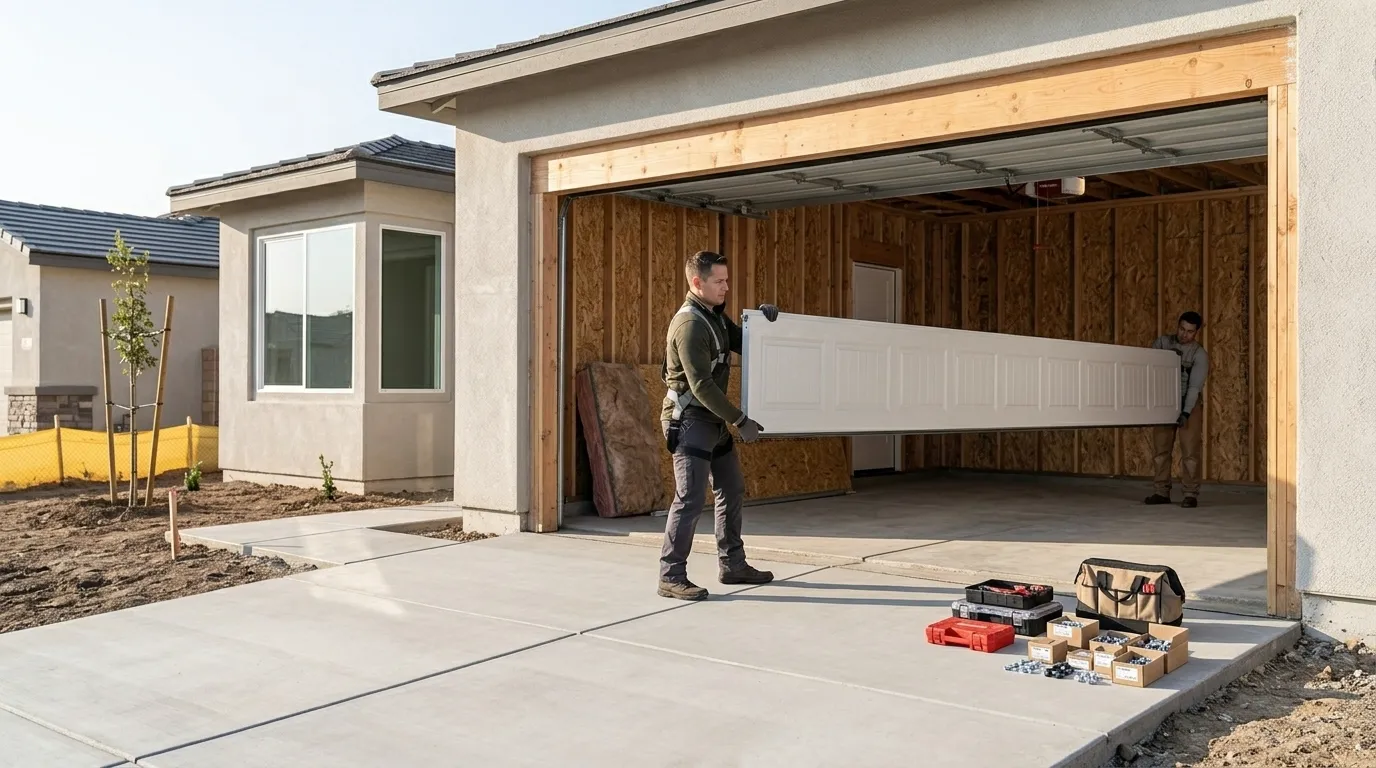
For a Callender install we bring the sectional door itself sized to the opening, the torsion spring rated to the door's actual weight, new lift cables, top and bottom brackets, rollers, and the track hardware, plus the opener if that's part of the job. Given the region's mild temperate climate, we're not building in the extra weatherproofing or insulation upgrades that a harsher climate would call for, which keeps the parts list simpler and the labor time shorter than it would be somewhere with real winter freeze-thaw cycles. What we won't have loaded by default is a custom-width panel for a nonstandard opening; those get special-ordered once we've measured, which is the one thing that can push a job out past the original estimate.
Most Callender homes went up around 1987, later than the 1979 median for the wider Santa Maria service area. That means the original hardware and opening sizes are more standardized and modern than what you'd find in an older tract, which usually makes sourcing a matching or upgraded door more straightforward.
Callender sits about 11 miles from Santa Maria. We travel out for installs and measure visits; there's no local branch in Callender itself, so scheduling factors in that drive time on both ends of the job.
You can handle demo and cleanup yourself, but the spring, cable, and balance work should go to someone trained for it. A torsion spring sized wrong for the door's weight is a serious injury risk, not just a comeback call.
The area sits in a mild temperate band, so we're not adding the heavy insulation or weatherproofing packages that a harsher-climate install would need. That keeps the standard sectional door and hardware setup appropriate for most Callender openings.
Call or request a quote - tell us what your door is doing and where you are.